Key takeaways
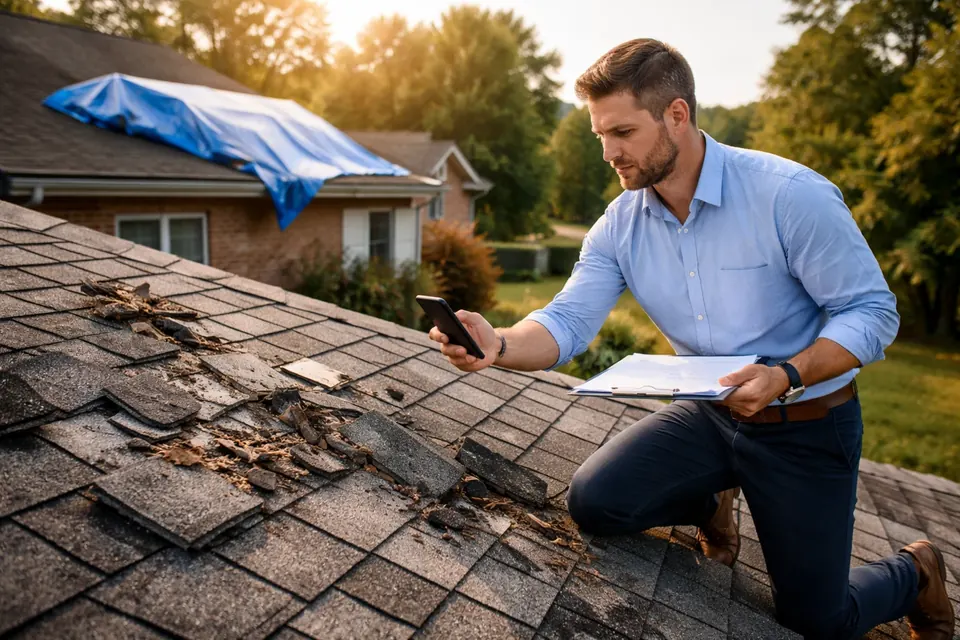
- After a fire you may deal with three kinds of adjusters: staff and independent adjusters work for the insurer; a public adjuster works for you.
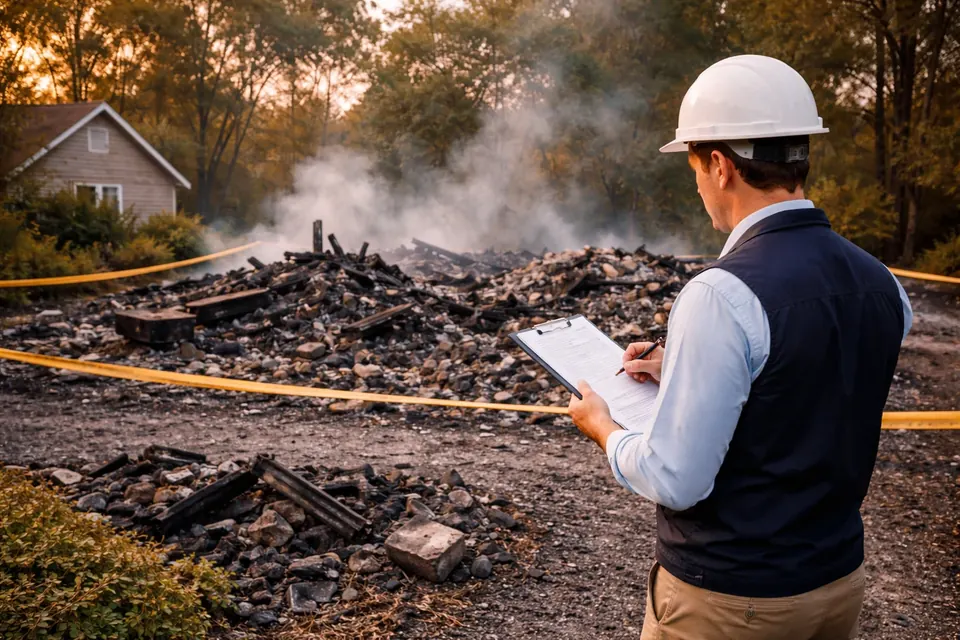
- A fire claim is rarely just burned materials. Smoke and soot, firefighting water, HVAC contamination, contents, debris removal, and living expenses all matter.
- Photograph everything before cleanup and keep damaged items until the insurer says you can dispose of them.
- Replacement cost and actual cash value can produce very different payments, so know which applies to each part of your policy.
- A public adjuster can help document and present a fire claim, but no one can promise the result.
A fire rewrites your plans in a matter of minutes. When the trucks pull away and the smell of smoke settles into everything, you are left with a damaged home or business, a family that may need somewhere to sleep, and an insurance claim that has to be built from scratch. Within days, you will meet a fire insurance adjuster. Knowing who that adjuster represents, what a fire claim should include, and how to protect your own interests can make the next few months far less overwhelming.
This guide is written for property owners in Dallas, Dallas County, and the surrounding North Texas communities. It covers the different adjuster roles, the parts of a fire loss that are often underestimated, a step-by-step claim timeline under Texas law, and how to decide whether a public adjuster is worth calling. It is general information, not legal advice; your policy and the facts of your loss control.
What is a fire insurance adjuster?
A fire insurance adjuster investigates fire damage, estimates the cost to repair or replace what was lost, and applies the policy to decide what is payable. The title can describe three very different roles:
| Adjuster | Works for | Paid by | What they do on a fire claim |
|---|---|---|---|
| Staff (company) adjuster | Your insurance company | The insurer (salary) | Inspects, writes the estimate, and applies coverage on the insurer’s behalf |
| Independent adjuster | Your insurance company, on contract | The insurer or an adjusting firm | Performs the same evaluation as a staff adjuster, often when claim volume is high |
| Public adjuster | You, the policyholder | You, under a written contract capped at 10% of the settlement | Documents the loss, prepares the claim, and communicates with the insurer for you |
The insurer’s adjuster is not your enemy. Many are fair and experienced. But their client is the insurance company, and their estimate reflects the carrier’s guidelines and pricing. A public adjuster, licensed by the Texas Department of Insurance under Insurance Code Chapter 4102, has a duty to the insured only. For more background, read what is a public claims adjuster.
What a fire claim really includes
The visible char is only one part of the loss. A complete fire claim usually involves several categories, each with its own documentation needs.
The structure
Framing, roof decking, drywall, insulation, flooring, cabinets, doors, windows, and electrical and plumbing systems. Heat travels well beyond the flames. Window seals fail, wiring insulation softens, and finishes blister in rooms that never caught fire. In older Dallas homes, such as Tudor and Craftsman houses in the Park Cities or pier-and-beam homes in Lakewood, Oak Cliff, and Kessler Park, opening walls can also reveal materials and wiring that complicate repairs.
Smoke and soot
Smoke moves through wall cavities, attics, and return-air pathways. Soot residue can discolor and damage some surfaces over time, and odor clings to insulation, carpet pad, upholstery, and clothing. Deciding whether an item can be cleaned, sealed, or must be replaced is one of the most common points of disagreement on fire claims. Our smoke damage claims page covers this in more detail.
Water from firefighting
Hose lines can put a great deal of water into a building. Wet drywall, subfloors, and insulation need to be dried or removed, and moisture left behind can lead to mold. That water damage is part of the fire loss and should be documented as such. See our water damage claims page.
HVAC and mechanical systems
Running the air conditioning or furnace during or after a fire can pull soot through ductwork into every room. Duct cleaning, coil cleaning, or replacement is easy to leave out of a first estimate.
Contents
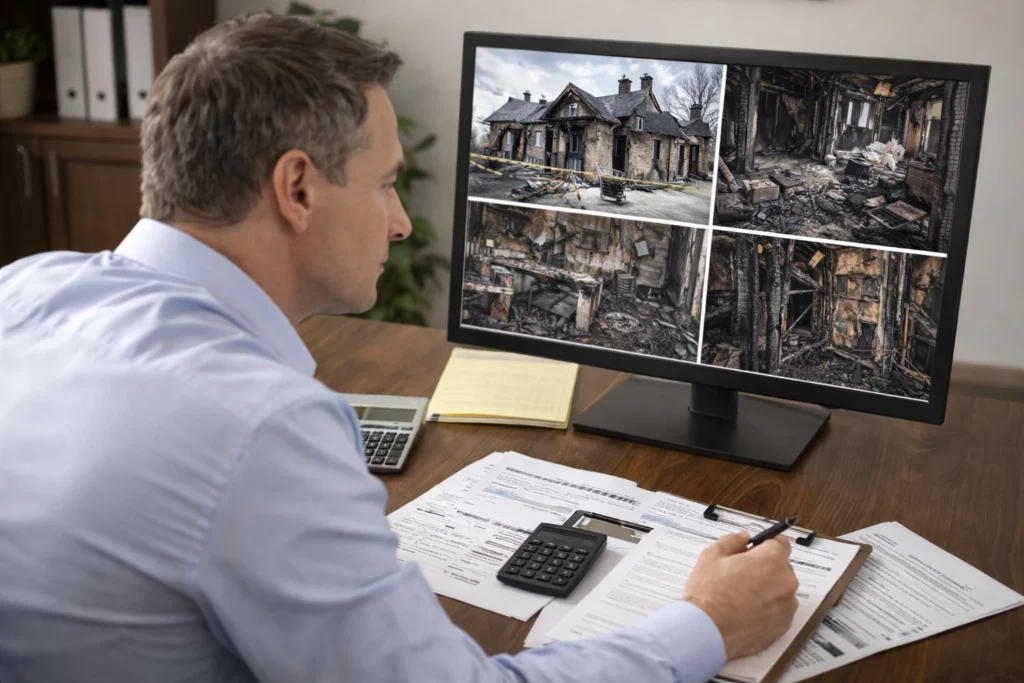
Furniture, clothing, electronics, tools, kitchenware, and everything else inside. A whole-home contents list can run to hundreds or thousands of items and is often the most time-consuming part of the claim.
Additional living expenses and debris removal
If the home is not livable, many policies pay reasonable extra costs such as lodging and increased food expenses, within policy limits. Debris removal, board-up, and fencing to secure the site may also be covered. Keep every receipt.
Code-related costs
Repairs may have to meet the City of Dallas’s adopted International Residential Code and International Building Code, or your suburban city’s requirements. Code compliance does not automatically mean the insurer pays for upgrades; that depends on ordinance or law coverage, which is often a separate, limited coverage. Our local building codes page explains how permits and code requirements interact with claims.
Step by step: a fire insurance claim in Texas
- Make the property safe. Do not go back inside until the fire department says it is safe. Arrange board-up and security to prevent theft and weather damage. Contact Oncor, Atmos Energy, and Dallas Water Utilities (or your city’s water provider) as needed about utilities. Reasonable steps to protect the property are often reimbursable, so save receipts.
- Report the claim promptly. Write down your claim number and the adjuster’s name, phone number, and email. Under Texas’s Prompt Payment of Claims law, the insurer generally has 15 days after notice to acknowledge the claim, begin its investigation, and request the information it needs.
- Ask about the fire report. The insurer may want the fire department’s incident report. Ask the responding department how to request a copy.
- Document before cleanup. Photograph and video every room, including closets, ceilings, the attic, the garage, and HVAC returns. Keep damaged items until the insurer says otherwise, as TDI advises.
- Attend the inspection. Walk the property with the adjuster if you can. Point out smoke in rooms away from the fire, water damage, and anything that smells of smoke.
- Review the estimate and build the contents inventory. Go through the structure estimate line by line and prepare a detailed contents list with descriptions, ages, and replacement prices.
- Decision and payment. After the insurer receives everything it requested, it generally has 15 business days to accept or reject the claim, or to tell you it needs more time, after which it has up to 45 more days. Payment is generally due within 5 business days of notifying you that the claim is accepted. If you have a mortgage, the check may include your lender.
- Recover depreciation. Under replacement cost coverage, the first payment is often actual cash value. The withheld depreciation is typically released after repairs or replacement are completed, often within a deadline stated in the policy.
Replacement cost vs. actual cash value on a fire claim
Two terms shape the size of each payment:
- Replacement cost value (RCV) is what it costs today to repair or replace with materials of like kind and quality.
- Actual cash value (ACV) is replacement cost minus depreciation for age and condition.
Say a ten-year-old dining table would cost $1,500 to replace today. Its ACV after depreciation will be lower. Under a replacement cost policy, you can usually recover that difference once you replace the table. Under an ACV-only policy, you generally cannot. Some policies treat the dwelling and contents differently, so check each coverage. Our claim calculator shows how deductibles and depreciation affect what you receive.
Building a contents inventory that holds up
This is where many households lose the most time. A few habits help:
- Work room by room in the same order: closets, drawers, shelves, walls, then floor.
- Use memory aids. Old phone videos, family photos, social media posts, and online order histories can remind you what was there.
- Describe each item specifically. “Queen mattress, about four years old, purchased online” is easier to price than “bed.”
- Gather proof where you can: credit card statements, receipts, warranty registrations, and manuals.
- Price at today’s replacement cost and note a comparable item and where it is sold.
- Separate cleanable items from non-salvageable ones, and explain in writing if you disagree with a decision on a particular item.
- Keep it in a spreadsheet with one line per item: room, description, age, quantity, and replacement price.
If the insurer requests a sworn proof of loss or an inventory by a certain date, check your policy and meet that deadline or ask in writing for more time. Our claim documentation checklist includes a contents section.
Common mistakes after a fire
- Accepting the first estimate without reading it. Check every room and every category against what you saw.
- Discarding items too soon. Photograph and list them first, and get the insurer’s OK.
- Not reading the policy. Know your dwelling and contents limits, deductible, living expense coverage, and whether you have ordinance or law coverage.
- Rushing the contents list. A vague list is harder to support than a detailed one.
- Letting a contractor “handle the insurance.” A contractor’s job is repairs. In Texas, a public adjuster also cannot be your contractor on a claim they are adjusting.

When to consider a public adjuster for a fire claim
Not every fire claim needs one. A small stovetop fire with limited smoke may be handled directly with the insurer. A public adjuster is more often worth considering when:
- The home or business is heavily damaged or cannot be occupied
- Smoke damage reaches well beyond the room where the fire started
- The contents inventory is large
- The insurer’s estimate is far below contractor bids
- Part of the claim was denied or the claim has stalled
- You simply do not have the time to manage a claim while your family is displaced
Fees are disclosed in a written contract before any work begins; Texas law caps public adjuster compensation at 10% of the insurance settlement, and you can rescind within 72 hours of signing. Our fire damage claims page explains how Dallas Public Adjuster approaches these losses, and knowing when to call a public adjuster covers timing.
Why local knowledge matters in Dallas
Dallas-area buildings vary widely: brick-veneer homes on slab foundations, mid-century ranches in Lake Highlands and Richardson, older pier-and-beam homes near Lower Greenville and in Oak Cliff, and commercial buildings with flat TPO or modified-bitumen roofs. Each affects how a fire spreads and how repairs are scoped. Work inside Dallas city limits generally needs permits through the City of Dallas Planning & Development Department, while cities such as Highland Park, University Park, Richardson, Garland, and Irving have their own building inspection offices. An estimate that reflects how the building is actually constructed, and what the permit process requires, is easier to support.
Final thoughts
After a fire, decisions come at you fast. Slow down where you can: secure the property, document everything, keep damaged items until the insurer says otherwise, and read every estimate before you agree to it. If the claim feels overwhelming or the numbers do not reflect what you lost, Dallas Public Adjuster serves Dallas, Dallas County, and surrounding North Texas communities and offers a free claim review. For legal questions, such as a coverage dispute or a deadline to sue, talk with a Texas attorney.
Frequently Asked Questions
Does the fire insurance adjuster work for me?
Not if your insurance company assigned them. Staff adjusters and independent adjusters evaluate the claim for the insurer, even when they are courteous and helpful. A licensed public adjuster is the only adjuster who represents the policyholder.
Can I throw away items damaged by the fire?
Wait until your insurer says it is OK. The Texas Department of Insurance advises keeping damaged property until the company tells you otherwise. Photograph and list everything first. If something must go for health or safety reasons, document it and tell the insurer in writing.
Will my homeowners policy pay for a hotel after a fire?
Many policies include additional living expense (loss of use) coverage when the home cannot be lived in. Limits and time periods vary by policy, so check your declarations page and keep every receipt for lodging, meals above your normal costs, and similar expenses.
Can I dispute the fire adjuster’s estimate?
Yes. You can submit your own documentation, contractor estimates, and a list of missing items and ask the insurer to revise its estimate. If the disagreement is about the amount of loss rather than coverage, your policy’s appraisal clause may be an option.
How much does a public adjuster charge on a fire claim in Texas?
Fees are disclosed in a written contract before any work begins; Texas law caps public adjuster compensation at 10% of the insurance settlement. You can rescind the contract within 72 hours of signing.
How long does a fire insurance claim take?
It depends on the size of the loss and how quickly information is exchanged. Texas law sets deadlines for the insurer to acknowledge, investigate, and decide a claim once it has the information it requested, but large fire claims with full contents inventories often take months to resolve.
Sources and further reading
This article is general information about property insurance claims in Texas, not legal advice, and not a promise of any coverage or outcome. Your policy language and the facts of your loss control your claim.